



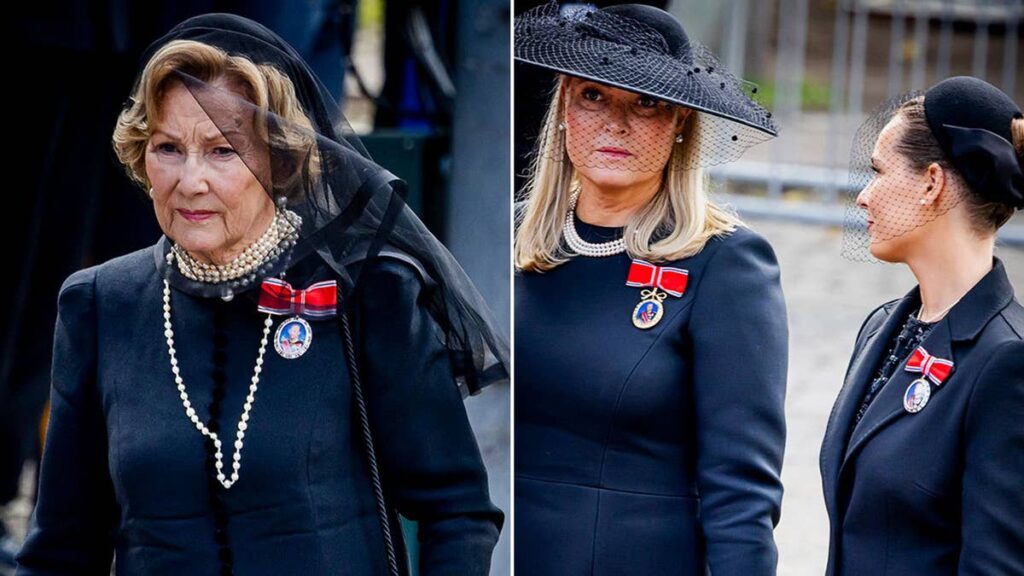
Royal family members from across Europe turned out in force to remember King Harald at his state funeral on Wednesday.
Prince William and Princess Anne led the arrivals at Oslo Cathedral following a funeral procession from the palace to honour the late Norwegian King, who passed away on 28 August, aged 89.
They followed a strict dress code, with Harald’s widow, Queen Sonja, 89, wearing a traditional black lace mourning veil to shield her face.
Meanwhile, Queen Mette-Marit, 53, Harald’s daughter-in-law, and Crown Princess Ingrid Alexandra, 22, his granddaughter, wore subtle netted veils over their faces.
Queen Mary of Denmark and Princess Charlene of Monaco were also spotted wearing an elegant take on the mourning veil.
Following King Harald’s passing, his son Haakon has become King, while Mette-Marit is now the Queen Consort of Norway.
Princess Ingrid is now heir to the throne, with Prince Sverre Magnus, 20, second in line.
Why are mourning veils worn at funerals, and are they obligatory?
Though they are not obligatory, royal women traditionally wear black mourning veils at the funeral of a sovereign.
They are both symbolic and practical, as a sign of respect and to shield the wearer from public scrutiny.
Typically, they are made from lace, tulle, or fine netting material, meaning the wearer can still see through them.
The long-standing tradition was made famous when Queen Victoria spent 40 years wearing black as a tribute to her late husband, Prince Albert.
Following in her footsteps, the late Princess Diana was seen wearing a black veil at Grace Kelly’s funeral in 1982, while Princess Kate wore a veil at the funerals of Prince Philip and the late Queen, in 2021 and 2022 respectively.
Often, the veil doesn’t cover the full face and is attached to the wearer via a headband or a hat.
Danielle Stacey, HELLO!‘s Royal Correspondent, explained previously: “Dressing head-to-toe in black is typically reserved for funerals and remembrance.
“Coincidentally, a black outfit is an essential item when all royals travel overseas, so that they are appropriately dressed in the event of a family death when they are abroad.”
The dress code at a royal funeral abroad
Marta Callejo, image consultant and protocol expert, told HELLO!‘s sister publication, HOLA! how British and Norwegian mourning can differ.
“At a royal funeral, the protocol doesn’t aim to highlight the person following it, but rather to build a collective image, fundamentally one of respect,” Marta explained.
“I think that, nowadays, we could say that protocol doesn’t consist of applying a list of prohibitions, but rather in understanding what each ceremony needs and adapting our image to it.”
“The goal is not to draw attention with black, but to visually disappear behind the meaning of the act,” he points out.
It means an array of simple silhouettes, structured coats, dresses, or suits with clean lines are often on display.
Other royal funeral dress traditions include wearing black and, for those who hold a military rank, wearing a uniform.
Prince William, however, did not wear uniform at King Harald’s funeral as he does not have the Order of St Olav.
Who is attending King Harald’s funeral?
Prince William is attending in an official capacity to represent his father, King Charles III. Meanwhile, Princess Anne made a “personal” appearance, as she is godmother to the new King Haakon.
The Norwegian monarchy, including Queen Sonja, King Haakon, and Queen Mette-Marit, is attending the service before appearing on the royal balcony.
Meanwhile, representatives from the Swedish, Danish, and Dutch royal houses are among those attending from the European royal houses.
Queen Margrethe of Denmark is one royal who isn’t attending, however, as she was taken to hospital over the weekend due to a blood clot and dehydration.
The Palace announced that the 86-year-old will be spending time away from the spotlight to recover and would no longer be travelling to Norway for the funeral.
Read the full article here