




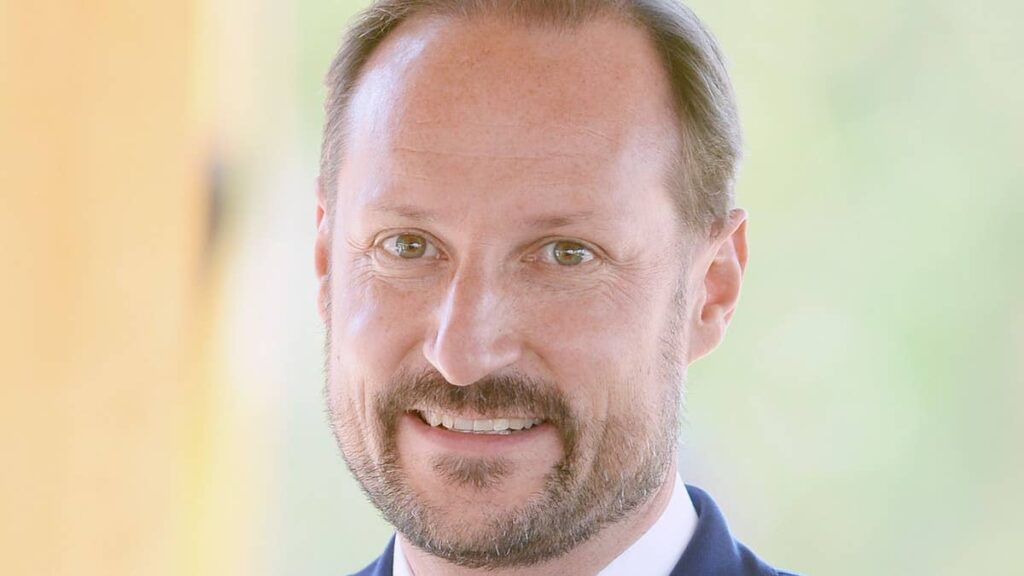
King Harald, who was on the Norwegian throne since 1991, has died at the age of 89 after being admitted to hospital on 17 August due to a blood illness.
Following Harald’s death comes the news of his only son as the new head of state. Norway’s royal family begins a new era as Crown Prince Haakon Magnus becomes King Haakon VIII and Haakon’s daughter, Princess Ingrid Alexandra, becomes the new heir apparent to the throne.
Like his predecessor, Haakon ascends Norway’s throne in his fifties. The 50-year-old Norwegian royal will sit at the helm with his wife of 23 years Crown Princess Mette-Marit. He lived a varied life including an idyllic countryside childhood, an unroyal university education at the University of California, Berkeley, and a naval career before settling down and welcoming two children.
Learn about his intriguing life in full…
His childhood
Crown Prince Haakon grew up in the Skaugum estate, which is so idyllic that he moved his wife into the home in 2003 following a period of renovations and is currently raising his children there.
The royal was born on 20 July 1973 at The National Hospital in St Hanshaugen, Oslo – the second child of King Harald V and Queen Sonja. He was given the name Haakon Magnus but his birth announcement stressed that he would be known simply as Haakon, after his paternal great-grandfather, Haakon VII.
Haakon became the crown prince at only 17 years old following the death of his grandfather King Olav. Unusually, he was educated at local state schools before embarking upon a four-year-long naval career, graduating from the Norwegian Naval Academy in 1995.
In 1999 he was awarded with Bachelor of Arts degree in political science from the University of California, Berkeley, having moved away from the expectation that he would attend Balliol College, Oxford as his father and grandfather had done before him.
Haakon continued to equip himself with a wealth of knowledge, graduating from the London School of Economics in 2003 with an MSc in development studies.
His siblings
Crown Prince Haakon has just one sibling – an older sister named Princess Martha Louise. She was born in 1971. Though the Norwegian constitution was changed in 1990 so that the first-born child would become the heir, regardless of sex, it was not altered retrospectively in the case of Haakon and Princess Martha Louise, hence she will not inherit the throne.
She is a businesswoman and a self-proclaimed clairvoyant who stepped down as a senior royal in 2022. It was announced that she would relinquish her royal duties to focus on her alternative therapy work alongside her ‘shaman’ fiance Durek Verrett.
A turning point
Haakon’s first major transition came at age 17 when his grandfather died,
On 17 January, 1991, when the 87-year-old King Olav suffered a heart attack at his Holmenkollen residence, the new king lost much more than a grandfather: he lost the margin of freedom provided by being the heir to the heir and realised – as he revealed in his biography – that the rest of his life would be marked by duty.
His royal relationship
Crown Prince Haakon met his now-wife Mette-Marit Tjessem Høiby in 1999 via mutual friends and she wasn’t necessarily the future queen his parents had envisioned. Mette-Marit was a single mother who had welcomed a child with Morten Borg, one of her ex-partner John Ognby’s friends who was also a convicted criminal.
The pair laid eyes on each other for the first time at a music festival and as their relationship developed, she was dubbed ‘Cinderella from Kristiansand’ by the Norwegian press due to her humble beginnings as the daughter of a former bank clerk.
The pair faced some backlash as the now Crown Princess was seen as an improper choice for the heir to the Norwegian throne due to her lack of formal education and royal upbringing.
Nevertheless, Haakon and Mette-Marit proved the strength of their bond, announcing their engagement in 2000 after his proposal on 1 December.
His wedding day
The happy couple tied the knot on 25 August 2001 at Oslo Cathedral. The 28-year-old bride looked so elegant in a gorgeous ivory wedding dress made from heavy silk crepe, with a corseted bodice.
She also secured her six-meter veil with a fairytale antique diadem – the bandeau of diamond daises tiara offered as a gift from her in-laws. Meanwhile, her husband donned a black military uniform.
In a fitting break from tradition, the bride walked down the aisle with Haakon on her arm instead of her father’s. “You have not chosen the easiest path, but love has triumphed,” the officiating Bishop Gunnar Stålsett remarked.
His children
Haakon and Mette-Marit share two children – Princess Ingrid Alexandra, 20, and Prince Sverre Magnus, 18.
Princess Ingrid Alexandra is now the heir apparent to Norway’s throne after her father. She was born in 2004 at The National Hospital in Oslo and was educated at the Uranienborg School in Oslo before enrolling at Elvebakken Upper Secondary School.
In the coming year, the future queen will undertake military training at the Engineer Battalion in Brigade Nord. Meanwhile, her 18-year-old brother is studying under the Information Technology and Media Production education programme at the upper secondary school Elvebakken.
He is also a stepfather to his wife Mette-Marit’s son, Marius Borg Høiby, from a previous relationship. What tested Prince Haakon the most as heir was undoubtedly the case of Marius Borg, who was sentenced to four years in prison for over thirty offences, including rape, domestic abuse against an ex-partner, assault, and threats.
His patronages
The future king has many passions which translate into his royal patronages. He is the face of over 10 organisations including The Norwegian Air Ambulance Foundation, The Norwegian Association of the Deaf, and The Norwegian Refugee Council
Regent before King
King Harald’s longevity and commitment to his oath meant he was frequently absent from public life toward the end of his reign.
That situation normalised the new King’s presence in all spheres of institutional life, including the most significant act the Norwegian Constitution reserves for the sovereign: the Opening of Parliament. Haakon VIII ascends the throne having led numerous Norwegian delegations abroad to promote commercial, cultural, and research interests, while keeping environmental protection aligned with technological and business development.
Yet he ascends at a difficult moment: inheriting the Crown from a deeply respected father, following Marius Borg’s conviction, Mette-Marit’s Epstein crisis and lung transplant, and at a time when the monarchy’s popularity has declined.
The ‘sensible’ King
The Norwegian press has referred to him as “sensible” on multiple occasions, but only time will tell which moniker history assigns him.
To quote Haakon himself, offering advice he gives his daughter Ingrid when she faces dilemmas in her role as heir: “Things often fall into place if you give them time.”
Now begins the era of Haakon VIII.
Read the full article here