
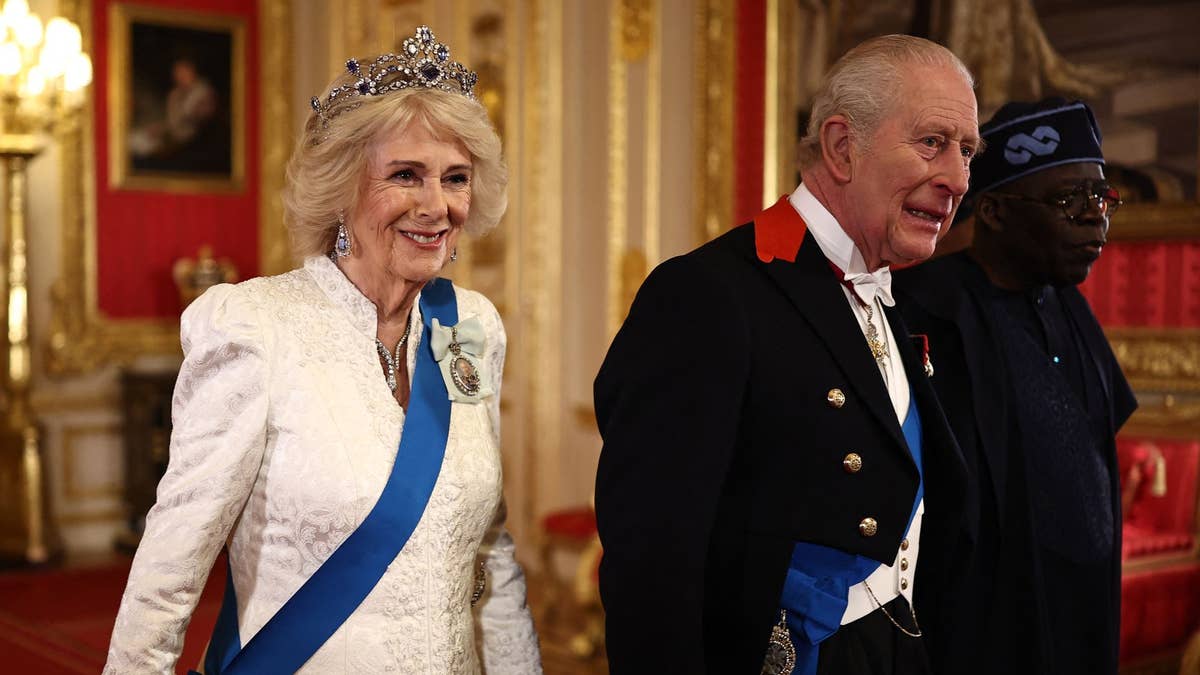

The King and Queen and Prince and Princess of Wales led President Bola Tinubu and First Lady Oluremi Tinubu in a royal procession to the glittering State Banquet at Windsor Castle this evening.
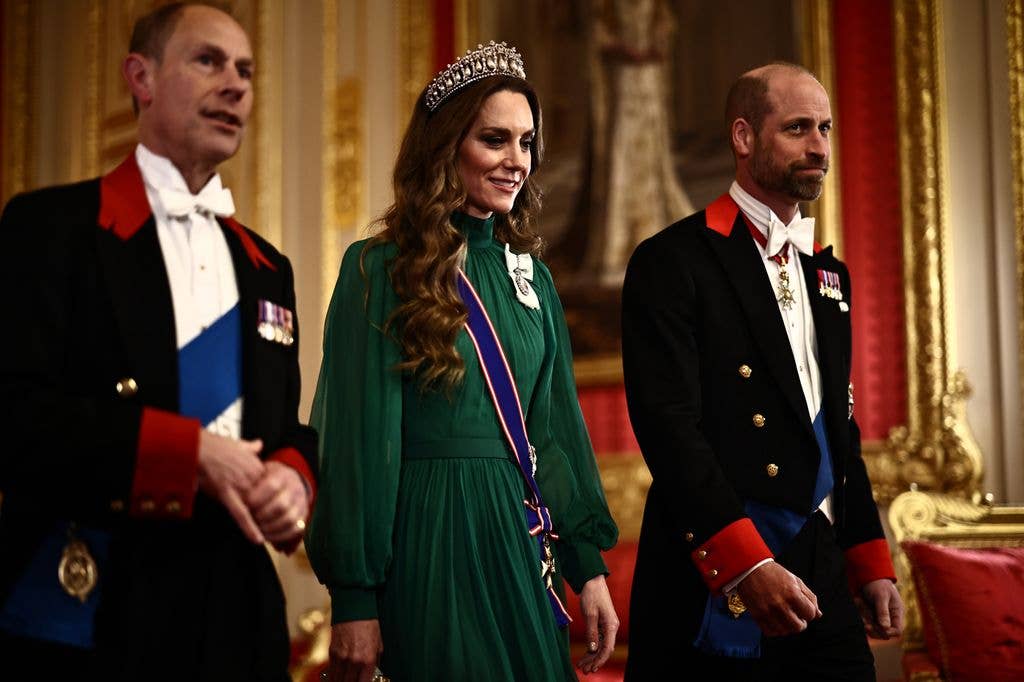
The Princess dazzled in a green dress by Singaporean designer Andrew Gn, the Lover’s Knot Tiara and earrings that belonged to the late Queen. She also wore the GCVO sash and star and the King’s Royal Family Order.
The Queen, meanwhile, wore a cream embroidered gown by Fiona Clare, a sapphire and diamond tiara with matching earrings that belonged to the late Queen, her own diamond serpent necklace, the Garter sash and star and the King’s Royal Family Order.
 © Getty Images
The King and Prince both wore white tie and Windsor tailcoats with their orders, medals and Garter sashes. William walked with Ambassador Bianca Odumegwu-Ojukwu, who sat to his right at the banquet, while Kate walked with Nigeria’s Minister of Finance, Adebayo Olawale Edun, who also sat to her right.
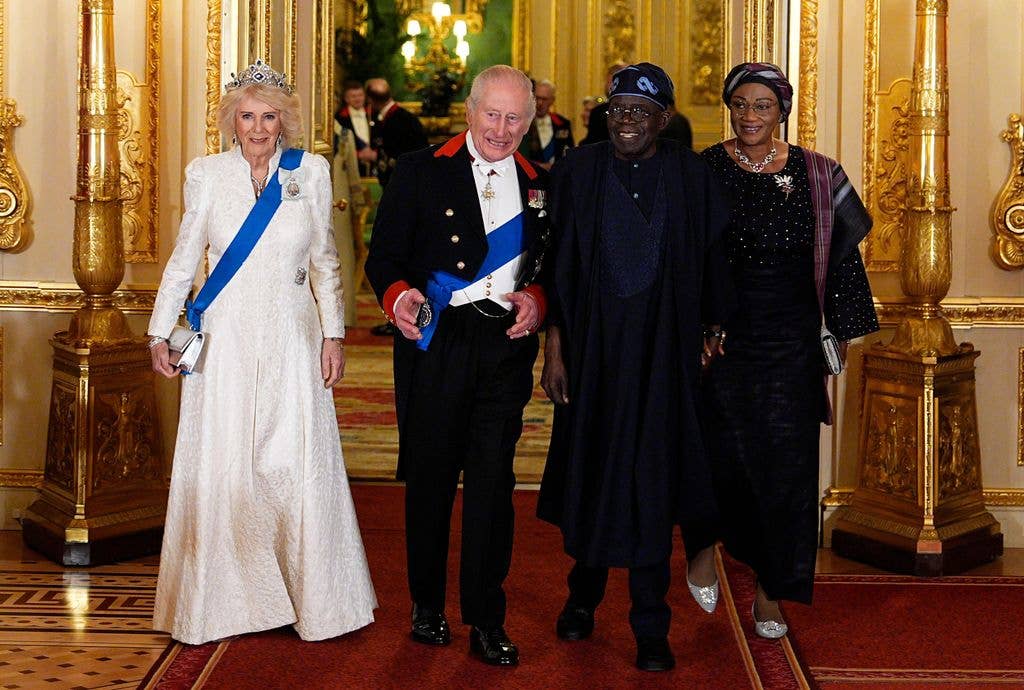 © Alamy Stock Photo
The Princess Royal, Vice Admiral Sir Tim Laurence and the Duke of Edinburgh made up the royal party, along with the Duke and Duchess of Gloucester.
Prominent British Nigerians also took part in the procession, including the astronaut Dame Maggie Aderin-Pocock, and former Olympic 400m champion Christine Ohuruogu. Inside St George’s Hall, they joined 160 guests, including England rugby captain Maro Itoje and wife Mimi, singer Tiwa Savage, author and poet Sir Ben Okri, footballer Eniola Aluko, former Paralympian Ade Adepitan and artist Yinka Shonibare.
Other notable names included Adejoké Bakare, the first Black female chef in the world with her own Michelin-starred restaurant, and Dame Elizabeth Anionwu, Emeritus Professor of Nursing at the University of West London.
Dining details and a royal first
The 47.32m-long table was decorated with seasonal flowers from the Windsor Estate and the Savill Garden, including narcissi, tulips, hellebores, hyacinths, primroses, mimosa and irises.
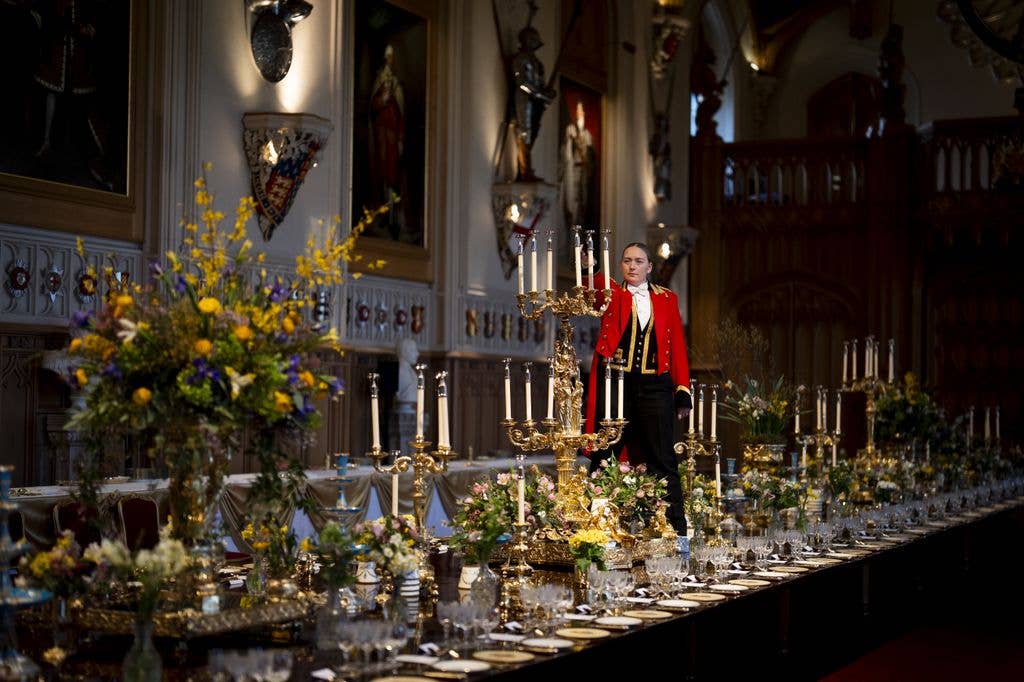 © Getty Images
As the State Visit was taking place during Ramadan, staff had prepared a prayer room for guests to use ahead of the banquet, and for the first time in living memory, offered canapés at the pre-dinner reception to allow those observing Ramadan to break their fast.
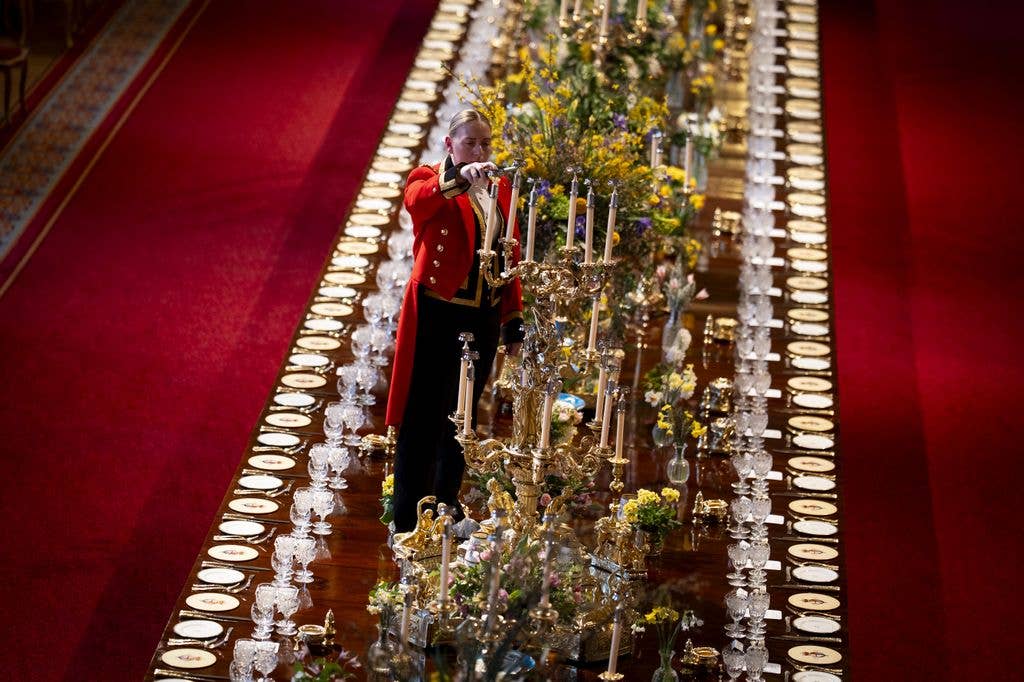 © Getty Images
They dined on a meat-free menu, starting with a soft‑boiled quail egg tartlet with watercress and kale and a basil sabayon, with a main course of fillet of turbot, lobster mousse wrapped in spinach, beurre blanc sauce, sprouting broccoli with hollandaise sauce, fricassée of peas and broad beans and Jersey Royal potatoes. Dessert was an iced blackcurrant soufflé with red fruit coulis. Wines included a Sugrue South Downs, Cuvée Boz, Blanc de Blancs from 2020, Domaine Vincent & François Jouard, Bâtard-Montrachet, Grand Cru, Vieilles Vignes, from 2022, a Château Pichon Longueville, Comtesse de Lalande, Grand Cru Classé, Pauillac, from 2000, and Louis Roederer, Brut Vintage, from 2000.
Following dinner, Dow’s 1983 Vintage Port and Bowmore Queen’s Cask 1980, Islay were on offer. As has become the tradition during the King’s reign so far, guests were offered a bespoke alcohol-free cocktail, crafted to represent the close relationship between the UK and Nigeria.
Called Crimson Bloom, it was inspired by the classic Chapman cocktail, a popular drink in Nigeria, and combines zobo and English rose, with grenadine and a hibiscus and ginger syrup, sharpened with fresh lemon and a hint of spice, and lengthened with English rose soda.
There was music from the Duchess of Edinburgh’s String Orchestra and, after dinner, a performance by Pipe Major John Mitchell from the 1st Battalion The Scots Guards.
The toast
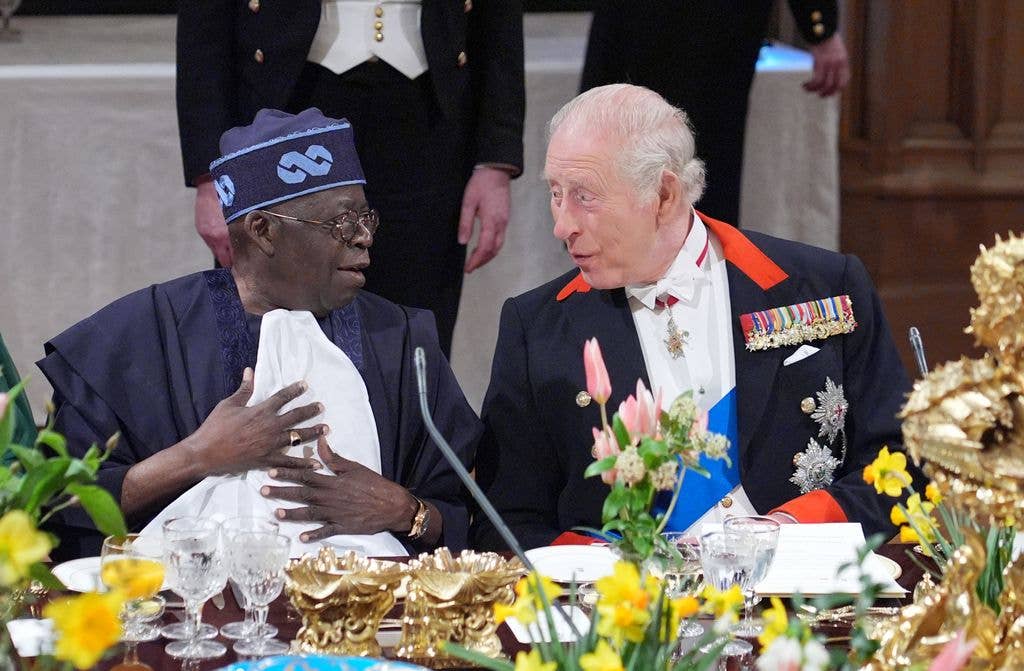
In his toast, the King spoke in both Yoruba and Pidgin and used well-known Nigerian sayings to pay tribute to his guests. “Ekabo. Se Daaa Daa Ni,” he began, which translates from Yoruba as “Greetings! I hope you are well.”
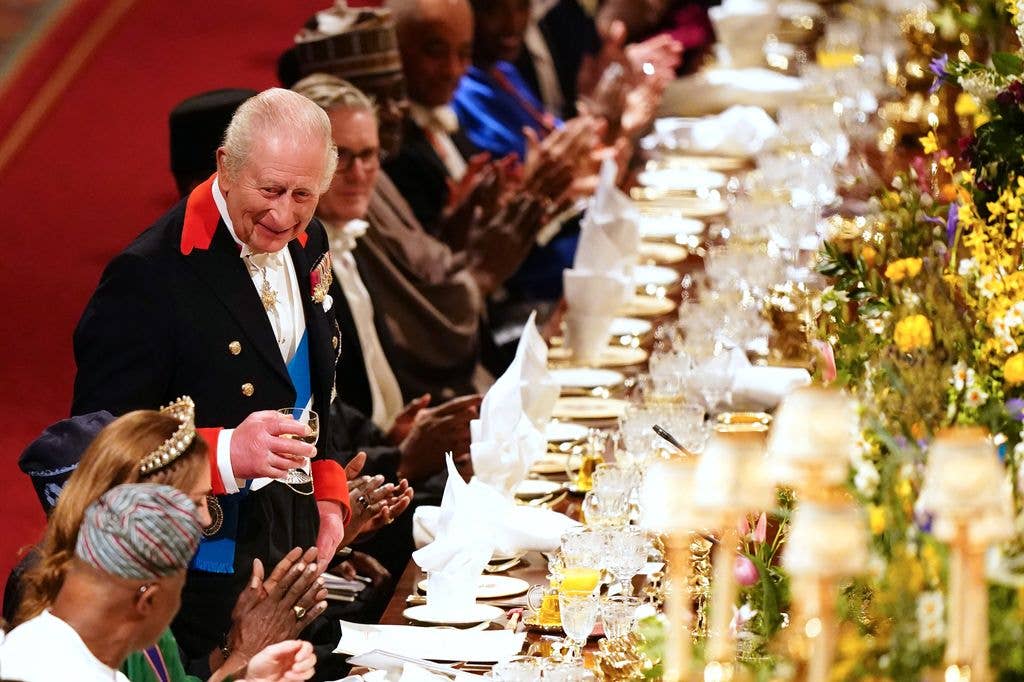 © Getty Images
The President threw his head back to laugh and applauded his efforts. He told President Tinubu – the first Muslim President to come to the UK on a State Visit during Ramadan since 1928 – “We are most grateful to you for travelling during this holy month which, I acknowledge, is no small sacrifice,” adding that “it is my particular pleasure to wish you, Mr President, peace, blessings, and an abundance of joy. Ramadan Mubarak!”
In a speech highlighting the impact of Nigerian culture on the UK, he said: “From Afrobeats filling our concert halls and Nollywood captivating our screens, to stars competing in our Premier League and adjudicating our highest courts, so much of Britain’s culture is, in truth, profoundly enriched by Nigeria.”
 © Getty Images
The King also touched on the “painful” past, referencing the historic slave trade. “There are chapters in our shared history that I know have left some painful marks,” he said. “I do not seek to offer words that dissolve the past, for no words can. But I do believe, as I know you believe, Mr President, that history is not merely a record of what was done to us – it is a lesson in how we go forward together to continue building a future rooted in hope and growth for all, and worthy of those who bore the pains of the past.”
He also spoke of the importance of the Commonwealth, citing the Yoruba saying: “Rain does not fall on one roof alone”. “I believe firmly that, when rain clouds gather, we can tighten the grip of friendship between us and, in so doing, reinforce the central role of the Commonwealth in our shared future.” He also used the Igbo saying, “Knowledge is never complete – two heads are better than one,” and the Hausa idiom, “when the music changes, so does the dance.”
With a population of 230 million people, half of whom are under 18, Nigeria this year became the UK’s biggest export market in Africa. The King signed off in Pidgin, saying: “Naija No Dey Carry Last!” which translates as Nigerians never come last and which was met with laughter and applause from the President and guests.
Read the full article here