



Inside author Emma Roig’s mountainside Ibiza villa

News Room By News Room
16 Min Read

Defined by her heritage, a lifelong devotion to the arts and a passion for learning about different cultures, the writer and journalist Emma Roig has carved out a multifaceted international career. Here, she welcomes us into one of her favourite spots – her villa in the heart of Ibiza – to discover the woman behind the public profile.

Emma’s foundations are rooted in a family that looms large over Spain’s business and cultural landscapes. Her father, Francisco “Paco” Roig, of the Mercadona dynasty – Spain’s largest supermarket chain – instilled in her the values of hard work and the importance of never taking anything for granted. Meanwhile, her mother, the Valencian gallerist Manuela Segarra, fostered Emma’s love of art from a young age.

© FERNANDA NAVARRO Y PALOMA ROJAS MARCOS FOR COUCHE STUDIO
Emma built the family villa from scratch

Multifaceted career

The living room which opens on to a serene courtyard © FERNANDA NAVARRO Y PALOMA ROJAS MARCOS FOR COUCHE STUDIO
The living room, which opens on to a serene courtyard

After studying journalism at the Complutense University of Madrid, Emma went to New York University on a prestigious Fulbright scholarship to complete her master’s degree, opening the door for her work in international media. She remained in New York City for more than a decade and, over time, her career gravitated towards the art world. She is not only a dedicated collector but also a global ambassador for Christie’s, as well as a culture and lifestyle columnist and editor, a TV commentator and a writer. 

One example is her book, Inside Ibiza, in which Emma moves past the party-island stereotype to reveal Ibiza’s sophisticated, artistic soul through its most private and beautiful interiors. Emma is married to a British financier of Iraqi heritage and has three children who have lived all over the world, from New York to London and Valencia. 

She champions her family’s multicultural ethos, maintaining a deep connection to their Spanish roots and traditions while embracing a global identity. She describes herself as someone who is used to not being tied to one place for too long, and with residences in Madrid, London and Ibiza, her life is a testament to a seamless blend of borders – both physical and creative.

Emma, tell us the story of this house…

The sofas are upholstered in Pierre Frey fabric in the living room of writer Emma Roig's Ibiza villa© FERNANDA NAVARRO Y PALOMA ROJAS MARCOS FOR COUCHE STUDIO
The sofas are upholstered in Pierre Frey fabric

“I wanted a sunset – or rather, 365 sunsets a year, because no two sunsets are alike. We found this mountain spot and I thought about building the family home here, settling down and stopping the annual hunt for a rental. I did overestimate my energy, though, and at one point I nearly gave up. I never imagined that the task of building something from scratch would be so complicated, but we carried on, and now that idea of a house is a home and an anchor point for the family.

“Light is very important to me, especially the zenithal light you see in Spanish Moorish baths or in my favourite building, the Pantheon in Rome.

“Our biggest challenge was the staircase. I wanted to pay homage to the one built by the Valencian architect Rafael Guastavino for Carnegie Mellon University in 1914. Although ours is white, we commissioned Valencian artisans to use traditional vaulting techniques.”

How would you describe the decor?

The living room, where art includes a Joan Miró tapestry, La Mangouste, from 1935 inside writer Emma Roig's Ibiza villa© FERNANDA NAVARRO Y PALOMA ROJAS MARCOS FOR COUCHE STUDIO
The living room, where art includes a Joan Miró tapestry, La Mangouste, from 1935

“Since I don’t have much patience, I started buying furniture all over the world even before construction began.

“I didn’t know where any of it would go, but every time I saw something beautiful, from ancient Cretan vases to modern art or wicker furniture, I would buy and store it. Little by little, it all began to take shape.

“If you look closely, the only real thread connecting everything is that it all fits the home I’ve always wanted to live in: one that is comfortable, perfectly proportioned and filled with both light and beauty.”

Your love for Ibiza led you to publish a book. What was that experience like?

The kitchen features Gordiola lamps, French vintage stools and Mark Hagen's painting To Be Titled (Addictive Painting 61) inside writer Emma Roig's Ibiza villa© FERNANDA NAVARRO Y PALOMA ROJAS MARCOS FOR COUCHE STUDIO
The kitchen features Gordiola lamps, French vintage stools and Mark Hagen’s painting To Be Titled (Addictive Painting 61)

“Vendome Press offered me the project. I had never done a coffee-table book, so I was excited by the challenge.

“The idea was to find 22 houses that strongly reflected the DNA of their owners. My guide was for them to reflect on different interpretations of their dream home. The houses are all very different, but what they have in common is that the owners all love Ibiza.

“Since the time of the Phoenicians, the island has attracted people with its energy and spirituality. Ibiza is much more than the parties, tattoos and excess that it has often been associated with.”

You are constantly on the move. How do you juggle this nomadic existence with art collecting and your family life?

The main dining room inside writer Emma Roig's Ibiza villa© FERNANDA NAVARRO Y PALOMA ROJAS MARCOS FOR COUCHE STUDIO
The main dining room

“The legendary Vogue editor Diana Vreeland once said: ‘The eye has to travel.’ I agree: the more you see, the more you perceive.

“My children have been raised and educated in different places, and I think having access to different cultures and adapting to them is important. If you are grounded in your roots, your branches can reach anywhere.”

Alejandro studied history at Georgetown University, but works as a sports manager in New York because football is his passion; Clara graduated with a degree in art history from New York University and is the events director for the London Design Festival; and Paco is studying international relations at Fordham University in New York.”

How did you get into art?

One of the bedrooms inside writer Emma Roig's Ibiza villa© FERNANDA NAVARRO Y PALOMA ROJAS MARCOS FOR COUCHE STUDIO
One of the bedrooms

“Art has always been my great love, second only to journalism. A friend once told me that you often feel freer when pursuing your second passion because the fear of failing at your first can be quite paralysing. I’ve always been passionate about art as a ‘hobby’, which is why starting to work for Christie’s was a dream.

“My first assignment for them involved closing the Vatican for a private tour for 30 collectors. To hear your footsteps echoing in the Sistine Chapel, and to wander those historic corridors with no one there but the Swiss Guard, was nothing short of pure magic.”

How did you start collecting art?

A brightly decorated bedroom inside writer Emma Roig's Ibiza villa© FERNANDA NAVARRO Y PALOMA ROJAS MARCOS FOR COUCHE STUDIO
A brightly decorated bedroom

“My mother told me that my first pay cheque should be invested in a piece of art, however small. We went to Arco [a contemporary art fair in Madrid] and I bought a José Guerrero screenprint that I still own.

“I started collecting when I was 20, but one of my most recent purchases is one of my favourites. Years ago, I became fascinated by the artist Françoise Gilot – the mother of Paloma Picasso and, famously, the only woman ever to leave Pablo Picasso. She had to brave Picasso’s fury; he threatened any gallerist who dared to support her.

“I eventually tracked down one of her paintings, completed during her first year with him, and bought it in a Christie’s auction.

“The piece is a powerful symbol of her life and journey. Her memoir and her legacy as a resilient woman continue to inspire me. She died in 2023, aged 101.”

You are the daughter of Francisco Roig, the former president of Valencia FC, and the niece of Juan Roig, the owner of Mercadona, and Fernando Roig, the president of Villarreal FC. You’re also a descendant of the founder of the Spanish footwear company Calzados Segarra. How has coming from one of Valencia’s most prominent business dynasties shaped you?

Emma Roig standing with her arms crossed© FERNANDA NAVARRO Y PALOMA ROJAS MARCOS FOR COUCHE STUDIO
Emma’s parents instilled in her the value of working hard and never
giving up

“Unfortunately, I haven’t inherited the family’s entrepreneurial flair. I’ve always been more drawn to the creative world, but I hope I’ve inherited their tenacity and the discipline to see an idea through to the end.”

Where does your artistic streak come from?

“From my mother. She used to take us to museums all over the world and knew them like the back of her hand. Whenever we got tired, she’d always say: ‘We’ll have a Coke and carry on.”

“She also took me to the Philharmonic in Valencia because she was passionate about classical music, and she kept a wonderful library because she loved to read.

“She eventually opened a gallery in Valencia and would take us to the painters’ studios. Her eye for beauty was innate; she designed her own jewellery, she decorated – she was incredibly cultured.

“She was my mother, of course, but in many ways, she was my teacher. She taught me that, since the dawn of time, human beings have sought beauty, not just survival. Look at the Altamira caves – what practical need did they have to paint those walls?”

”My father threw me into a pool so I’d learn to swim’

Emma Roig

You had a previous career as a journalist. What made you move into the art world?

One of the bathrooms inside writer Emma Roig's Ibiza villa© FERNANDA NAVARRO Y PALOMA ROJAS MARCOS FOR COUCHE STUDIO
One of the bathrooms

“When I moved to London and had my third child, I simply couldn’t keep up the pace of life as a journalist. The art world was the perfect fit for a new chapter.

“There’s always an excitement in starting something fresh professionally, and learning about a new world. I’ve been fortunate enough to find fantastic people to guide me every time I’ve changed direction.”

How do you remember your childhood?

The outside view of the villa © FERNANDA NAVARRO Y PALOMA ROJAS MARCOS FOR COUCHE STUDIO
The outside view of the villa

“I remember my father throwing me into a swimming pool so that I’d learn to swim. Swimming is still one of my favourite things to do. There’s nothing quite like gliding rhythmically through the water.

“He also once put me in front of a small bull calf – he told me that it would rid me of my fear of whatever might come my way.”

What values did your family instil in you?

“To work, and to work hard. When I was a teenager, my father made me work Saturdays at Mercadona so that I could learn about life. My parents taught me that a sense of purpose is fundamental, and that you mustn’t give up as long as you have a shred of strength left.”

What do you enjoy doing in your leisure time?

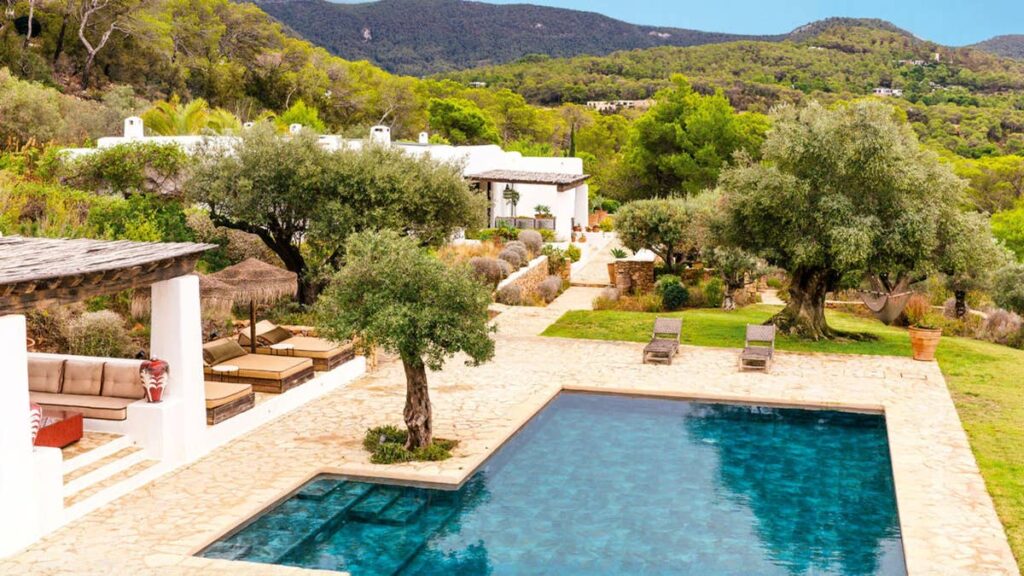
A view of the long outdoor pool© FERNANDA NAVARRO Y PALOMA ROJAS MARCOS FOR COUCHE STUDIO
The villa has an outdoor pool

“Hiking, swimming, sailing and skiing – though I’ve broken my fair share of bones and ligaments! Now, my children joke that it’s time for me to take up something a bit safer, like embroidery or cooking. I don’t think that’s going to happen.”

What would you say has been your most transformative experience?

“When the September 11 attacks happened in New York, we were living very close by. After covering the news, I got into the car to take my children, who were only three and 18 months old, to somewhere safer.

“As people began streaming away from the towers, walking towards me like zombies, I had a sudden thought: if I go back for my camera, this will be the pinnacle of my career. Instead, I hit the accelerator and headed north.

“At that moment, I realised that being a mother was the most important thing in my life.”

How did you and your husband meet?

The outdoor dining area© FERNANDA NAVARRO Y PALOMA ROJAS MARCOS FOR COUCHE STUDIO
The outdoor dining area

“At a party in England, where he was living at the time. We talked all through dinner and then I didn’t see him again, although I kept thinking about him. A year later, he moved to New York, where I was living, and we ended up sharing a house in The Hamptons with a group of friends… the rest is history.”

Do you have any unfulfilled dreams?

“I prefer to let life surprise me.”

What do you value most in life?

“The people I love, and the sense of curiosity and enthusiasm that life stirs in me.”

Read the full article here

TAGGED:
Share This Article
Leave a comment