



From priceless Dolly Parton and Lucille Ball moments to Donald Trump’s takeover

News Room By News Room
16 Min Read

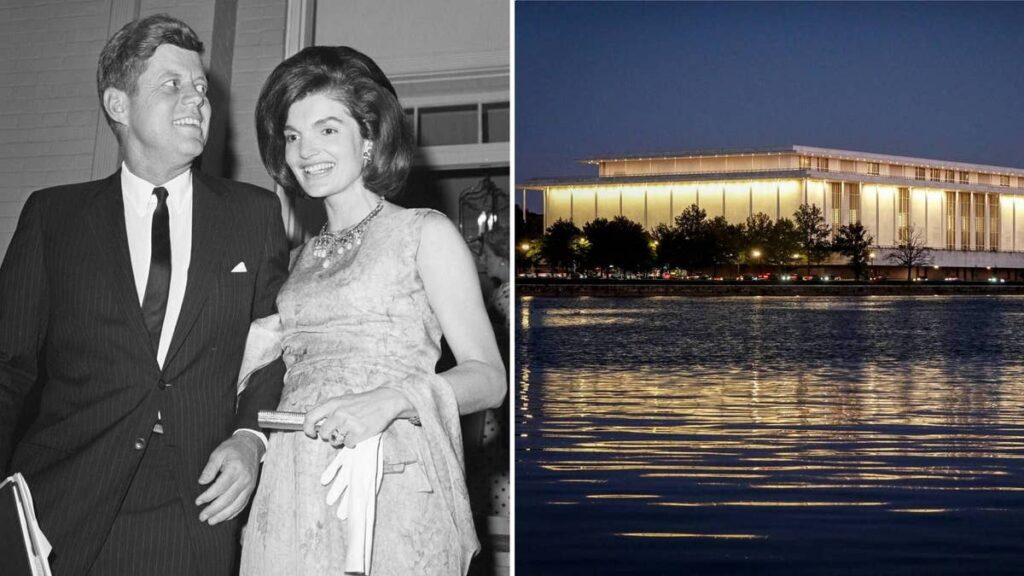
The Kennedy Center, whose fate as a national cultural center remains uncertain, has a more precarious history than many might realize.

Though the famed Center did not open until 1971, the idea of it first came to Eleanor Roosevelt, known for professionalizing the role of first lady, in 1933, during the throes of the Great Depression; she proposed a national cultural center that could employ out-of-work actors. 

Congress passed a resolution to move forward with such a building in 1933, but it wasn’t until 1958 that it gained momentum as part of the National Cultural Center Act, which President Dwight D. Eisenhower signed into law. According to Ralph E. Becker’s 1990 book, Miracle on the Potomac, Eisenhower’s push for the project helped make culture “a legitimate concern of public policy.”

© Getty Images
Eisenhower and Kennedy, pictured in Palm Springs in 1962, shared a mutual vision of a national culture center

The building wouldn’t be completed until 1971, two years after Eisenhower’s death, and for the next nearly five decades it was sustained by bipartisan support, considered a symbol of the symbiotic, mutually beneficial relationship between the arts and democracy. At a 1962 fundraiser for the Center, President John F. Kennedy declared: “As a great democratic society, we have a special responsibility to the arts, for art is the great democrat calling forth creative genius from every sector of society, disregarding race or religion or wealth or color.”

Public opinion of the project was always largely positive, save for debates about its location, but that wasn’t always evident in its fundraising efforts. It only saw moderate success before Kennedy was assassinated in 1963, a tragedy which caused funding and support for the Center to skyrocket. 

11/11/1962 -- Pictured: (l-r) First Lady Jacqueline Kennedy, NBC News' Sander Vanocur discussing plans for the new National Culture Center (later renamed The Kennedy Center) in the Diplomatic Reception Room of the White House on November 5, 1962© Getty Images
The former first lady in November 1962 discussing plans for what was then referred to as the National Culture Center
Examine Model of Kennedy Center; Mrs. Jacqueline Kennedy (right) and Mrs. Joan Braden examine a model of the Kennedy Center for the Performing Arts in the office of architect Edward Durrel Stone, April 2nd. The Center will be built in Washington. Mrs. Braden's husband is running fot Lt. Gov. of California.© Getty Images
Jackie examining blueprints for the Kennedy Center around 1966

Now, the Center finds itself in financial straits once again. Donald Trump, who added his name onto the building as one of his first acts of his second term, has prohibited much-needed renovations from taking place, until his name, along with credit for the renovations, are added back to the building, despite a federal judge ruling it unlawful. On Tuesday, September 15, the Trump-appointed board voted for the shutdown and the President declared the Kennedy Center will close until it is once again “The Donald J. Trump and the John F. Kennedy Memorial Center for the Performing Arts.”

Below, revisit the landmark moments in the Kennedy Center’s history.

President John F. Kennedy, left, looks at a model of the Kennedy Center October 8, 1963 in Washington, DC.© Getty Images
JFK looking at a model of the Center on October 8, 1963, just over a month before his assassination

1961: Kennedy takes on fundraising

After Eisenhower signed the National Cultural Center Act in 1958, the building of the Kennedy Center became the first time that the federal government helped finance a structure dedicated to the performing arts. Edward Durell Stone was the designated architect, and by 1959, estimated costs for the center rose to $61 million.

Fundraising efforts were, however, unsuccessful, with only $13,425 raised in the first three years. It was JFK who became the driving force to reignite the project, though only more so posthumously, having only raised $13 million prior to his November 1963 assassination.

It was really his death that truly galvanized support for the project, with his vice president turned president Lyndon B. Johnson passing a measure indicating that the center would be renamed after the late president: the John F. Kennedy Memorial Center for the Performing Arts. 

With members of the Kennedy family looking on, president Johnson lifts a shovel full of dirt during ground-breaking ceremonies for the John F. Kennedy Center for the Performing Arts. Watching are Mrs. Jean Smith, the late President's sister; Mrs. Lyndon B. Johnson; Robert F. Kennedy; and Mrs. eunice Shriver, another sister. 1964© Getty Images
President Johnson at the Kennedy Center groundbreaking in 1964. Behind him are JFK’s sisters Jean Smith and Eunice Kennedy Shriver, plus his brother Robert F. Kennedy
View, from the Potomac River, of the construction of the John F Kennedy Center for the Performing Arts, Washington DC, December 29, 1967© Getty Images
It took nearly seven years from groundbreaking to opening for the Center to be constructed

With a total construction cost of $70 million, Congress allocated $43 million in funds, with donations covering another significant portion, including $500,000 from the Kennedy family themselves. Johnson dug the ceremonial shovel at the December 1964 groundbreaking in Foggy Bottom, but there was continued debate about the location for another year. Excavation began in December 1965, and the site was finally cleared by January 1967.

View of, from left, American philanthropist Rose Kennedy (1890 - 1995) (left), her grandson, Edward M Kennedy Jr, daughter-in-law Joan Bennett Kennedy, granddaughter Kara Kennedy (1960 - 2011), and son Senator Edward M 'Ted' Kennedy (1932 - 2009) as they  arrive for the opening performance at the John F Kennedy Center for the Performing Arts, Washington DC, September 8, 1971© Getty Images
Kennedy matriarch Rose Fitzgerald (1890-1995) with other members of the Kennedy family, including Ted Kennedy, at the Kennedy Center opening in September 1971
Maria Shriver, far right, at the grand opening of the JFK Center for the Performing Arts in 1971. She is flanked by her father and mother, Sargent Shriver and Eunice Kennedy, and siblings Tim and Robert Jr.© Getty Images
Maria Shriver with her parents Eunice Kennedy and Sargent Shriver as well as siblings Tim and Robert Jr. at the opening

1971: Opening night

The center, built with 17,000 tons of steel from Pennsylvania and Carrara marble from Italy, finally opened in 1971, 40 years after it was first ideated. The New York Times dedicated five columns on a full page to the center’s opening event, which was attended by members of the Kennedy family, including Edward “Ted” Kennedy, Eunice Kennedy Shriver, and Kennedy family matriarch Rose Fitzgerald, as well as actor Gregory Peck. Honorary chair Jacqueline Kennedy pulled out of attending the event only a week prior, though she requested that Leonard Bernstein compose a piece for the premiere evening, “Mass.” The famed composer said he was “stunned” sitting through two performances and two standing ovations for it.

“It’s very exciting,” Robert F. Kennedy’s widow Ethel Kennedy told the Times of the big night. “I’ve been waiting for it a long time.”

Mrs. Jacqueline Kennedy Onassis passes a huge bronze bust of her late husband, President Kennedy, as she enters the John F. Kennedy Center for the Performing Arts on June 5th. Visiting the Center for the first time, Mrs. Onassis is escorted by Roger Stevens, Chairman of the Board of the Center. The former First Lady attended composer-conductor Leonard Bernstein's production of "Mass," which is dedicated to the late President 1972© Getty Images
Jackie, above passing a huge bronze bust of her late husband, did not attend the Center’s opening. She visited for the first time in June 1972 to see a production of Bernstein’s “Mass”
Modern crystal and metal chandeliers, a gift from Sweden, add to the glittering look of the foyer of the John F. Kennedy Center for the Performing Arts, which opens formally September 9th. The center, whose total cost is estimated at $68,000,000, houses a theater, an opera house, a concert hall, and a film theater.© Getty Images
The interior of the Center, including the famed chandeliers, prior to opening

With a total building size of 1.5 million square feet, the center boasts a 618-foot long, 60-foot high foyer and 400 rooms in total. The foyer is adorned with 18 of the “world’s biggest chandeliers,” per the Times’ 1971 reporting, seven of which were gifts from Norway, and a bust of President Kennedy sculpted by Robert Berks. Audiologist Cyril M. Harris designed the acoustics specifically to drown out the sounds of car traffic. 

National Symphony Orchestra, under the baton of Music director Antal Dorati, rehearses for the first time in the concert hall at the Kennedy Center for the Performing Arts. The Center will formally open with a performance of Leonard Bernstein's "Mass".© Getty Images
The National Symphony Orchestra inside the Center, which also houses a theater and concert hall

The Times also described the Kennedy women’s glittering fashion on the long-anticipated night. Rose wore a gown of “iridescent pastels threaded with silver,” adorning her ears with diamond pendants; Ethel dressed in white crepe, and Eunice a rose red taffeta gown by Pierre Cardin; Joan Kennedy opted for a long lavender crepe dress with slits “to the tops of her thighs in swirling panels that revealed matching hot pants beneath.”

Lucille Ball and Ray Charles at the Kennedy Center Honors in 1986© Getty Images
Kennedy Center honorees Lucille Ball and Ray Charles at the Kennedy Center Honors in 1986
Dolly Parton at the Kennedy Center© Getty Images
Dolly Parton, a fierce philanthropist in addition to revered singer-song-writer, was honored at the Center in 2006

1978: The first Kennedy Center Honors

In 1978, the Center began honoring renowned American artists and performers annually with what became known as the Kennedy Center Honors, which were hosted for the first time by Bernstein himself. They became one of the Center’s most well-known and beloved traditions, which every president generally participated in until Trump, who put an end to the tradition during his first term.

Aretha Franklin rehearsing for Inaugural Eve program for newly elected US President Jimmy Carter and Vice President Walter Mondale at the Kennedy Center, 1977© Getty Images
Aretha Franklin rehearsing for Inaugural Eve program for President Jimmy Carter and Vice President Walter Mondale at the Kennedy Center, 1977
In a star-studded celebration on the Kennedy Center Opera House stage, Seiji Ozawa, Rita Moreno,Carole King, George Lucas and Cicely Tyson will be saluted by great performers from Hollywood and the arts capitals of the world on THE 38TH ANNUAL KENNEDY CENTER HONORS, to be broadcast Tuesday, Dec. 29 (9:00-11:00 PM, ET/PT) on the CBS Television Network. Pictured: Aretha Franklin© Getty Images
The singer’s 2015 performance of “(You Make Me Feel Like) A Natural Woman” is one of the most memorable the Center has hosted

2015: Aretha Franklin’s tear-jerking performance

One of the most memorable Kennedy Center Honors performances was Aretha Franklin’s 2015 tribute to Carole King. The legendary “Respect” singer, clad in a rhinestone-bedecked gown and floor-length fur coat, sang an unforgettable rendition of “(You Make Me Feel Like) A Natural Woman,” which was co-written by King, bringing to tears not only the honoree but also then-President Barack Obama.

Visitors browsing a photography exhibition in the lobby of the Kennedy Center, Washington, DC, circa 1995. Formally the John F Kennedy Center for the Performing Arts, the cultural centre is on the eastern bank of the Potomac River in Washington, DC© Getty Images
The Center pictured in 1995

2019: REACH expansion

The Center expanded for the first time in its nearly 50-year history in 2019 with the opening of REACH, designed by Steven Holl Architects, which began construction in 2013. REACH stands for Renew, Experience, Activate, Create, and Honor, and honors Kennedy’s aspirational vision for the nation. The expanded campus added new gardens, additional studios, meeting and performance spaces. The $250 million expansion was described by the Center as a “21st century cultural arts campus and arts incubator.”

Kennedy center along the potomoc, ca. December 4, 1971, Washington, DC, USA© Getty Images
The Center sits on the edge of the Potomac River

2025-2026: Trump’s overhaul

While in his first term Trump largely avoided the Kennedy Center, in his second, he has done as much as possible to make it his own, even if it means shutting it down. Shortly after his 2025 inauguration, and firing most of the Center’s previous leadership, he announced himself as its new chairman, and appointed several allies to the board of trustees. That December, the board voted to rename the center “The Donald J. Trump and the John F. Kennedy Memorial Center for the Performing Arts,” which was briefly made reality on the Center’s façade, before a federal judge ruled the name change unlawful.

Construction workers build scaffolding near the sign for the Donald J. Trump and John F. Kennedy Memorial Center for the Performing Arts on June 12, 2026 in Washington, DC. The Kennedy Center board voted to seek an emergency appeal to block a court order requiring the removal of President Trump's name from the Kennedy Center, but a judge denied their request© Getty Images
A federal judge stopped the Kennedy Center Board of Trustees’ latest plan to add Trump’s name to the memorial for JFK

Trump subsequently threatened to close the Center should his name — along with an inscription that reads “Restored and Renovated by President Donald J. Trump” — not be added back, claims that came to a head on Tuesday, September 15. 

In a tense board meeting during which Trump called in, he reportedly screamed at and berated Democratic Rep. Joyce Beatty, whose lawsuit has prevented his name from being added back to the building. The board voted to close the Center for renovations, though Trump subsequently maintained that renovations will not happen without his name back on the wall. 

16 September 2026, United States, Washington D.C.: A view of the Kennedy Center early in the morning. Washington's largest public cultural institutionthe Kennedy Centerwill be closed immediately, according to the U.S. president. He stated on his platform, Truth Social, that the reasons for this are security concerns and urgently needed renovation work. However, the work cannot begin until an appeals court has ruled on the planned name change.© Getty Images
Trump kept the Center open long enough to appoint himself its chairman, and host a premiere of a documentary on Melania Trump, which was funded by Amazon
SEPTEMBER 15, 2026: A security officer guards the entrance area at the John F. Kennedy Center for the Performing Arts in Washington, D.C. September 15, 2026, where the center's board voted today to close the main building. Hours earlier, a judge had blocked efforts to add President Donald Trump's name to the venue building again© Getty Images
President Trump’s handpicked board has warned in documents that the institution faces ‘certain fiscal collapse within weeks’ unless his name is added back to the building

“The closing will take place immediately, however, the Renovation and Reconstruction, which is a very large and complex job, cannot begin until such time as the D.C. Circuit rules on the Board’s approved name,” he wrote on Truth Social. The Center, which is projecting a $23 million deficit following plummeting sales since Trump’s overhaul, now faces continued financial uncertainty. On Thursday, September 17, Trump was photographed inside Air Force One reading a placard that reads “Kennedy Center DEMOLITION.” 

The following day, Hands Off the Arts scheduled a community action — dubbed Hands Around the Kennedy Center  —  to protest the closure and “uplift the Kennedy Center.”

Read the full article here

TAGGED:
Share This Article
Leave a comment