

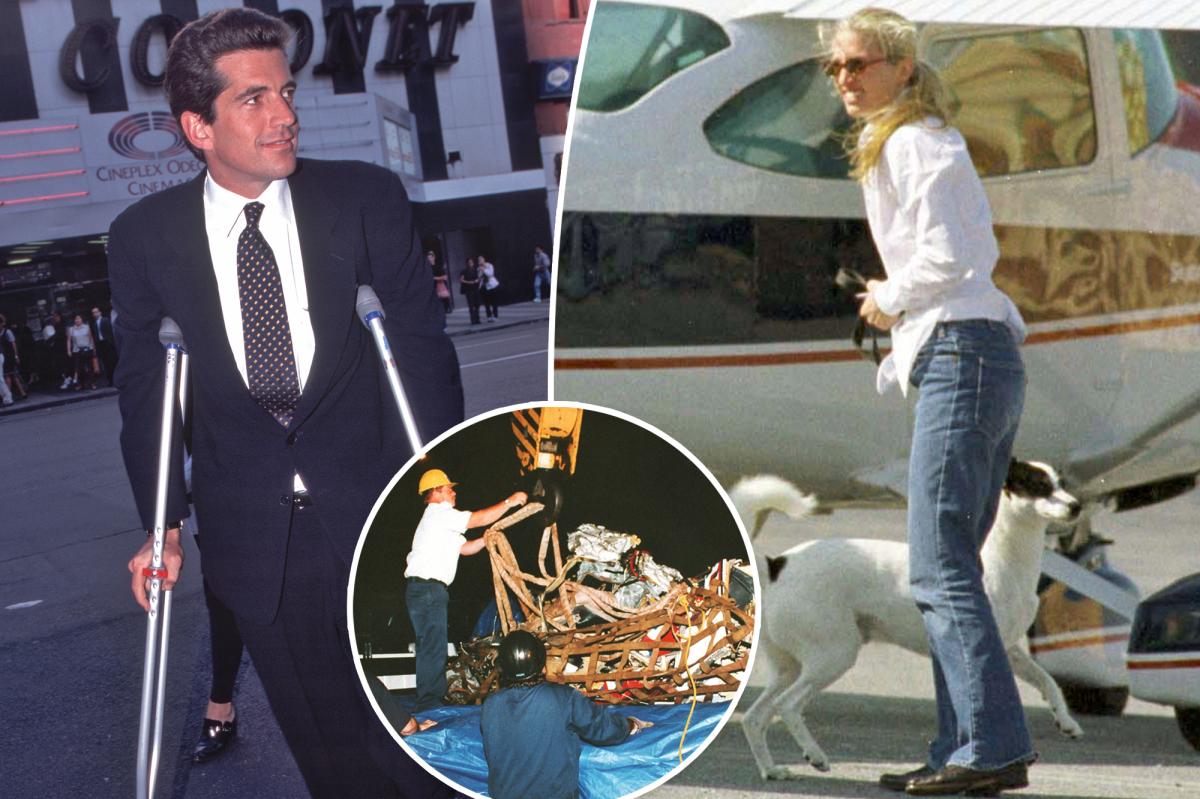

Several witnesses, pilots and medical experts uncovered the eerie warning signs that were ignored before John F. Kennedy Jr., his wife, Carolyn Bessette, and her sister, Lauren Bessette, tragically perished in a deadly plane crash.
On the hazy evening of July 16, 1999, JFK Jr. — the son of late President John F. Kennedy and Jacqueline Kennedy Onassis — was piloting a small aircraft.
John was planning on flying the red and white Piper Saratoga from Essex Airport in Caldwell, New Jersey, to Martha’s Vineyard (to drop off Lauren), and then to Hyannis Port with Carolyn for his cousin Rory Kennedy’s wedding. But the couple never made it.
Investigators believe John experienced spatial disorientation — the mistaken perception of one’s position and motion relative to the earth — causing the aircraft to plummet into the ocean, killing everyone aboard.
Page Six obtained the March 2000 factual report conducted by the National Transportation Safety Board, which examines the bone-chilling moments leading up to the deadly crash that left the country in collective grief.
Landing help
Just weeks before his fatal crash, John relied on his flight instructor to assist him with landing an airplane he was flying due to an ankle fracture he had sustained one month prior.
According to a summary of an interview with one of John’s flight instructors, he was “wearing a non-plaster cast on his leg” which required the instructor “to taxi the airplane, and assist with the landing.”
The unnamed instructor also told investigators that John, referred to as the “accident pilot” in the report, was “not ready for an instrument evaluation as of July 1, 1999” and “would need additional training and instruction before passing the evaluation.”
This instructor did note, however, that John seemed “competent” with the autopilot.
Last lunch fears
Richard Blow, a senior editor at John’s George Magazine, had lunch with his boss on the day of the deadly accident, according to the NTSB report.
“The witness had lunch with the pilot the day of the accident, and he stated the pilot was in good [spirits],” a memorandum included in the report states.
“During the lunch, the witness expressed concern to the pilot about his injury and flying,” the report continues. “The pilot responded [saying that] he was looking forward to the flight.”
Blow told investigators that John “was frustrated about injuring his ankle” and “not being able to fly.”
The journalist concluded that John was “a seriously devoted student of flying” and “worked hard at developing his flying skills.”
Flying solo
John refused to fly with a flight instructor on the day of the accident, according to a memorandum.
Robert Merena, one of John’s instructors, stated that he offered to fly with John on that tragic day.
“The instructor stated that he talked to the pilot on the day of the accident, and offered to fly with him on the accident flight,” the memorandum states.
John told the flight instructor that he “wanted to do it alone,” Merena claimed.
“In addition, the instructor restated that he was not aware of the pilot ever flying the accident airplane without an instructor onboard,” the memo states.
Mixed reviews
John had worked with a number of flight instructors over the years — with each teacher offering different opinions about his skill set, according to the documents.
One instructor described John’s flight abilities as “average, not a standout.” The same instructor, who believed John “stopped his instrument training” because of his injury, “showed improvement after each flight” and “seemed well attuned with his abilities.”
John’s primary instructor felt his basic instrument flying skills and simulator work were “excellent.” However, he noted that “when given multiple tasks while flying,” John had “trouble managing those tasks.”
A third instructor described John’s skills as “average,” while a fourth said he had “excellent” situational awareness and general knowledge of aviation and flying.
Weather worries
There was very little visibility on the evening John departed in the accident plane, according to the report.
Per a pilot who was planning a flight from Caldwell to Martha’s Vineyard on the night of the accident, around the time John’s flight took off, it was “extremely hazy.”
The pilot shared that he canceled his flight due to “the current weather conditions at COW, the fact that I could not get my friends to come with me, and the fact I would not have to spend money on a hotel room in Martha’s Vineyard.”
When asked about that evening’s weather conditions, Merena told investigators he “would not feel comfortable with the accident pilot conducting night VFR on a similar route, and in similar weather conditions as during the accident.”
Using crutches
Medical records show that John fractured his ankle in a hang gliding accident on June 1, 1999. The next day, he underwent surgery for the injury.
On the day of the accident, a witness recalled seeing John walking on crutches. He also saw his sister-in-law “retrieve a walking cane from a white convertible” before returning to the airplane.
John’s physical therapist noted that he couldn’t determine whether the Kennedy scion’s gait was “due to this ‘slight’ limitation of motion or due to mild pain.”
However, John’s orthopedic surgeon weighed in, saying he believes the pilot would have been able to “apply the same pressure to his left foot that is required of the right foot during emergency braking of an automobile.”
The doctor confirmed that John wasn’t prescribed any medication for his injury.
There has been renewed interest in JFK Jr. and his wife due to Paul Anthony Kelly and Sarah Pidgeon portraying them in Ryan Murphy’s “Love Story” series, streaming now on Hulu.
Read the full article here