




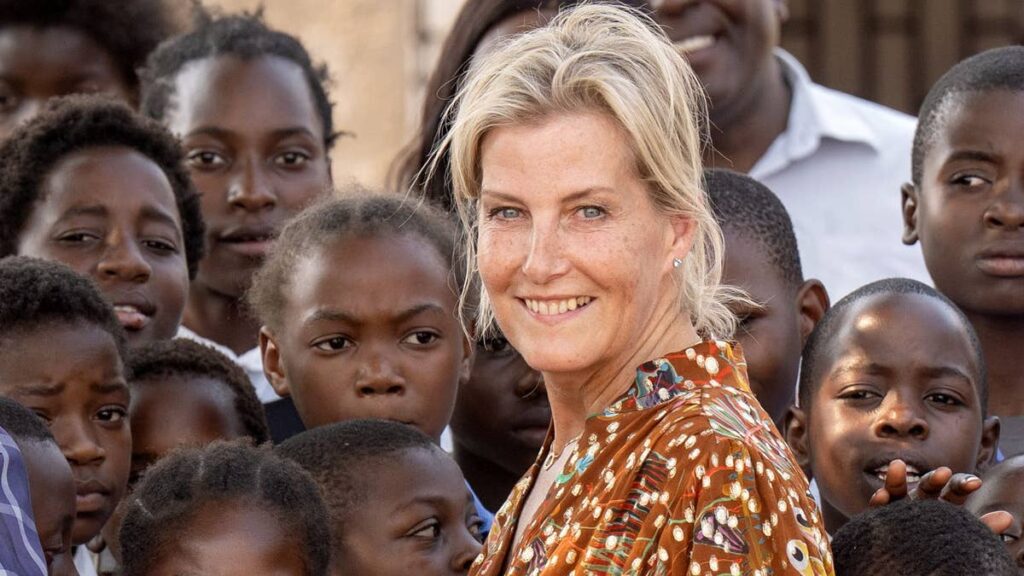
The Duchess of Edinburgh wakes in her tent at the camp at Lower Zambezi Conservation to find a pile of fresh elephant dung within sniffing distance of her door.
The deposit, whose creator has wandered back into the bush or into the current of the Zambezi river, was not Sophie’s closest animal encounter of the night, however. Over breakfast at the conservation outpost, where she is staying to learn about the fight against poachers, she tells fellow guests about waking in the small hours to find herself face to face with a hippopotamus.
Asked how close, she recalls that it would have been no nearer if it had been sitting on the chair outside her front door.
The Duchess and the wild animal exchanged looks as she moved her bedsheet, the slight noise drawing the hippo’s attention. She reconsidered getting out of bed to take a closer look: they were already close enough.
So begins Sophie’s fourth day of her five-day visit to Zambia, which now takes her to Livingstone in the south of the country and the roaring spectacle of Mosi-oa-Tunya, the local name for what the explorer David Livingstone named Victoria Falls. The local name means “the smoke that thunders”.
Flight from the bush
Her visit means flying from an airstrip deep in the Zambian bush aboard a 12-seater Cessna turboprop aeroplane known as “the Land Cruiser of the sky”, alongside a handful of aides and Hello!’s reporter, the only writer covering her five-day tour.
We land in Livingstone to be greeted with a traditional welcome dance at the airport entrance, which involves a man with elaborate shoulder decorations falling to his hands and knees in front of the Duchess and shimmying like an agitated lion.
Memorial to the fallen
Her first stop is a war memorial dedicated to Zambian residents who died in the First World War while resisting the German East Africa Campaign and travelling to fight in Europe.
The Last Post blares from a portable speaker, marking the beginning of a two-minute silence before it is broken by Reveille. The Duchess places a posy of flowers at the base of the cenotaph with a handwritten note: “Lest we forget.”
Unusually for a royal service of remembrance, monkeys join the occasion, sitting down to groom one another or chew their own feet.
One tour guide expresses concern that a monkey will make off with the flowers. “They’re likely to,” he says. “They take anything they want.”
When the Duchess departs, the posy remains unstolen. Among the former soldiers at the ceremony is Peter Jones, a local historian who served in the Falklands with the Royal Engineers before returning to serve with the Black Watch, now part of The Royal Regiment of Scotland, which included being posted to Northern Ireland during the Troubles.
After the ceremony, he escorts Sophie to the falls, where she mingles with tourists pleasantly surprised to find themselves chatting to a member of the royal family.
Sporting action
The Duchess’s next visit begins with a rousing performance of drumming and singing as she arrives at Maramba primary school, where pupils are given sporting opportunities by the Zambian non-governmental organisation Sport in Action.
The school grounds teem with children as they show their skills at football and netball, which Sophie unexpectedly joins by asking to take some shots on goal. She makes five attempts but achieves only near misses.
She also joins young children gathered in a circle to dance and chant with them in an exercise designed to motivate them before a match.
Kelvin Malambo, the school’s headmaster, says that the school has been “blessed” to have her as a guest. He hopes that it will bring attention to problems such as water shortages preventing the school from having running water for the past week. “So children have to be sent home halfway [through the day],” he says. “Also, when the children play sport, they cannot wash afterwards, so they go home sweaty.” He waves his hand under his nose to mimic the reactions that parents have when their children arrive in need of a wash.
Sport in Action, which was founded in 1998, not only runs sporting projects for 17,000 people in Zambia but helps to run the Duke of Edinburgh Award scheme in the country. Some of the children at Maramba are wearing netball skirts with badges from the University of St Andrews, one of five universities to donate new or second-hand kit to Zambian schoolchildren.
Staffsone Phiri, a district coordinator for the NGO, says that he sometimes gets into trouble because the children don’t want to stop playing.
“The parents all have my number and they call me, saying: ‘Where is my child?'” Sophie completes her visit with a group photograph with all the children crowded around her in a mildly chaotic huddle. “It’s only about 10,000 degrees here,” she says with a laugh. “Don’t worry.”
Read the full article here