


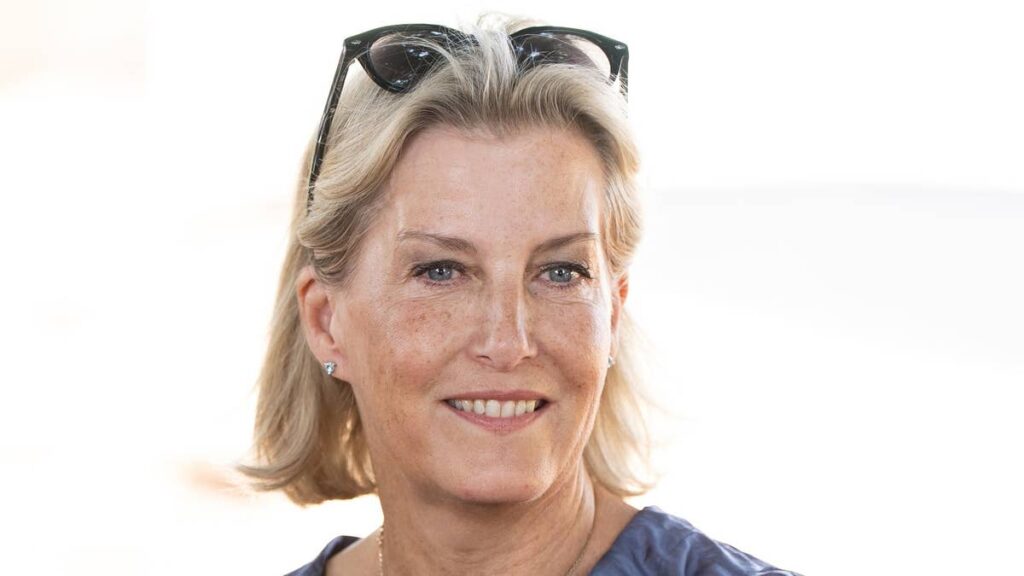
It is not until the final day of the Duchess of Edinburghâs tour of Zambia that she gets to dance with people whose lives have been transformed by the cause closest to her heart.
Sophie, whose five-day tour of the southern African country has included a tour of Victoria Falls and a night-time encounter with a hippo, throws herself into a dance led by Zambians who have been cured of a disease that would have made them blind.
As the only reporter on her five-day tour, I witness her strutting joyfully to chants, in the local language, that translate as: âWe are happy because now we can see.â
The celebration comes after heartfelt stories from six people who suffered from trachoma, an illness that, left untreated, causes eyelashes to turn inwards. The constant irritation leads to permanent sight loss.
Duchess Sophieâs personal crusade
The Duchess is a champion of the fight against preventable sight loss, having helped her daughter Louise, now 22, overcome problems with her vision when she was younger.
Samson Mwiya, who has travelled from his farm to Mukuno Rural Health Centre, near the city of Livingstone, to share his story, tells the Duchess that his eyes itched constantly.Â
âThe pain was too much. I felt that there was mud in my eyes.â He was spotted by a volunteer for the clinic, who encouraged him to go for treatment. Samson describes his fear when he saw his sister Alice with a bandage over her eyes after she emerged from her operation.
He found the courage to undergo the treatment anyway. Â âWhen they removed the bandages from my eyes it was like they were still closed,â he says. âBut after the fourth week, my eyes were clear. The mud had gone.â
He is grateful to the British charity Sightsavers, which is working with the Zambian government to eradicate trachoma as a public health problem, as they successfully did in Malawi in 2022.
Priscah Mwanaseluka, who has her six-month-old baby slung to her side, tells Sophie how she couldnât understand why she was no longer able to see well enough to go to school, do household chores or work in the fields. She says that the operation transformed her life.
âAfterwards, I was able to get married and have two children,â she says, as her youngest one looks around the group.
Sophie says that âitâs the worst condition to haveâ.Â
âWe all know what itâs like just to get one eylash in your eye, and itâs horrible. To have all your eyelashes do that [is unimaginable].â
The Duchess departs to pay a visit to Libuyu Primary School, to hear about the work of Wish (Womenâs Integrated Sexual Health), which is seeking to improve the lives of women by offering high quality treatment for family planning and reproductive health, as well as changing attitudes towards gender-based violence.Â
The Duke of Edinburghâs present
Her final engagement of the tour, at the Wayi Wayi art studio, leads to a suggestion that harmony may not always reign in her household.
She is shown a knobbly ceramic vessel created by the artists Lawrence and Agness Buya Yombwe, a husband and wife who studied in Britain and have set up a studio and workshop in Livingstone.
The artists tell the Duchess that it is a âdialogue dynamicâ pot. It features two spouts, designed to show that one person can speak through one spout but it ceases to work if two people speak at once, as an allegory for couples who talk over one another.
Sophie is taken with the idea. âActually, I think my husband might want one of these,â she says.
After a tour of the coupleâs other work, which explores social issues including gender relations, mutual respect and the prevention of domestic violence, it is time for her Zambia trip to end. If she feels exhausted by the intense series of engagements, she doesnât let it show. She climbs into her four-wheel drive car, waves at me, and disappears from view on the dusty, unmetalled road.
Read the full article here